




Choosing a reaction wheel comes down to five criteria: the angular momentum your mission must store, the torque your manoeuvres require, the mass and power budget, the microvibration level your payload can tolerate, and the lifetime the wheel must guarantee.
Here is how to work through each one.
Which Comat reaction wheel for your mission?
Comat offers two reaction wheel ranges, covering satellites from 10 to 1,000 kg:
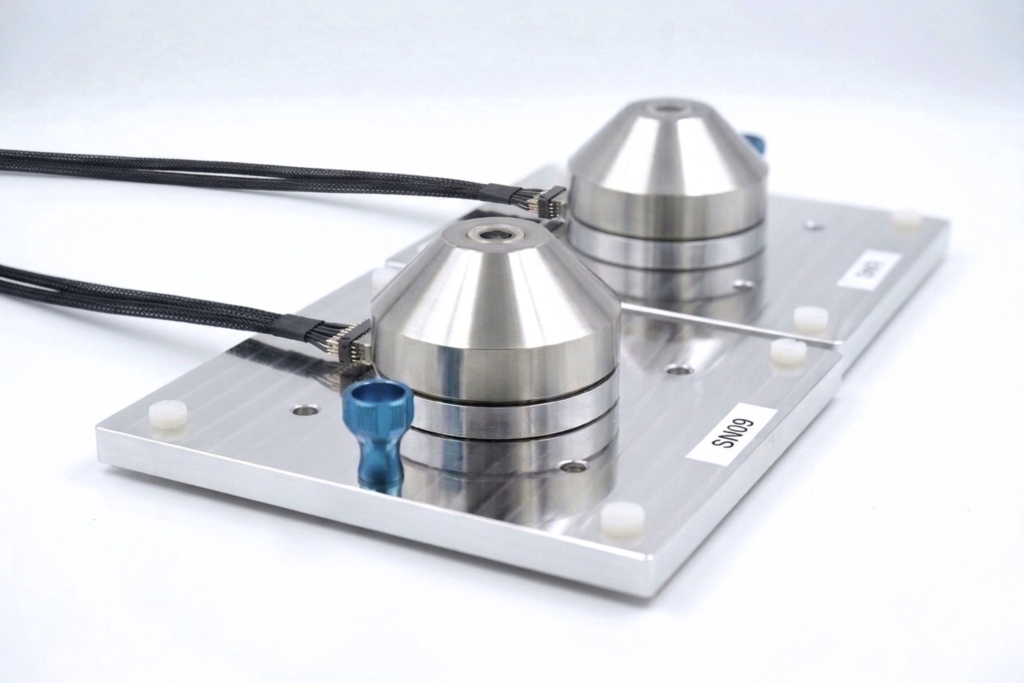
Light Series:
20 mNms to 2 Nms, for satellites from 10 to 200 kg. It meets the needs of small satellites and constellations, where compactness, mass and power consumption are critical.
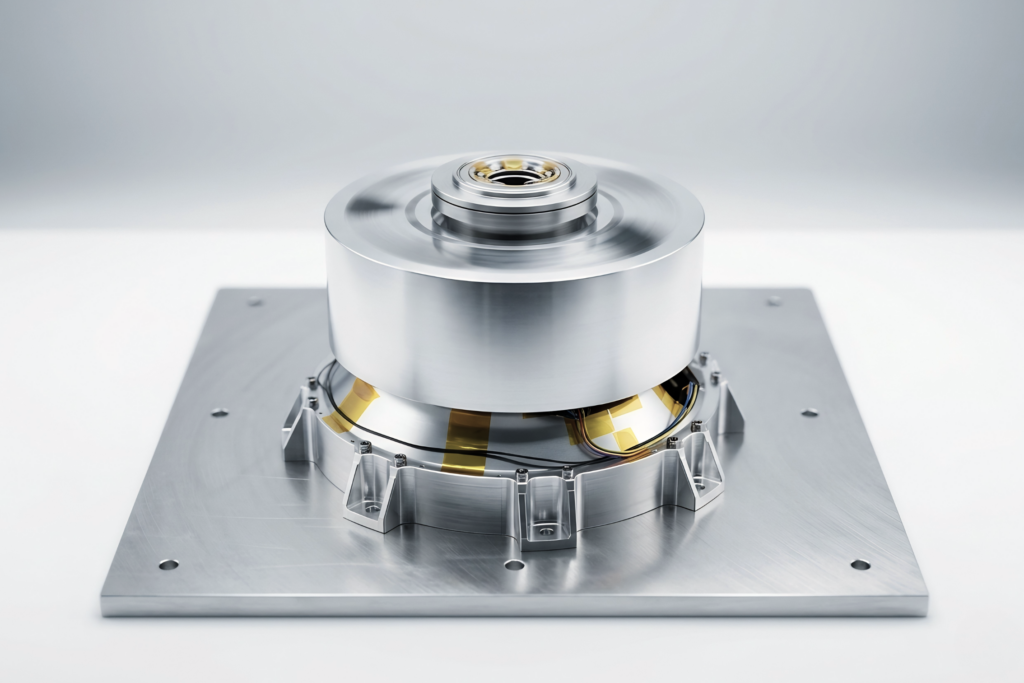
Heavy Series:
6 to 50 Nms, for satellites from 200 to 1,000 kg. It serves heavier platforms and agile missions that require high momentum storage capacity.
1. Start with angular momentum storage (Nms)
Momentum capacity, is the first sizing parameter. It sets how much disturbance the wheel can absorb before it saturates and needs to be unloaded. In orbit, a satellite is constantly exposed to small external torques: atmospheric drag in low Earth orbit, solar radiation pressure, gravity gradient and residual magnetic dipole. The wheel stores the momentum these torques build up between two desaturation phases.
Momentum capacity also limits slew performance. To point quickly at a new target, the wheel must exchange enough momentum with the platform. As a first approximation, the larger the satellite’s inertia and the more agile the mission, the higher the capacity you need.
2. Check the torque for agility
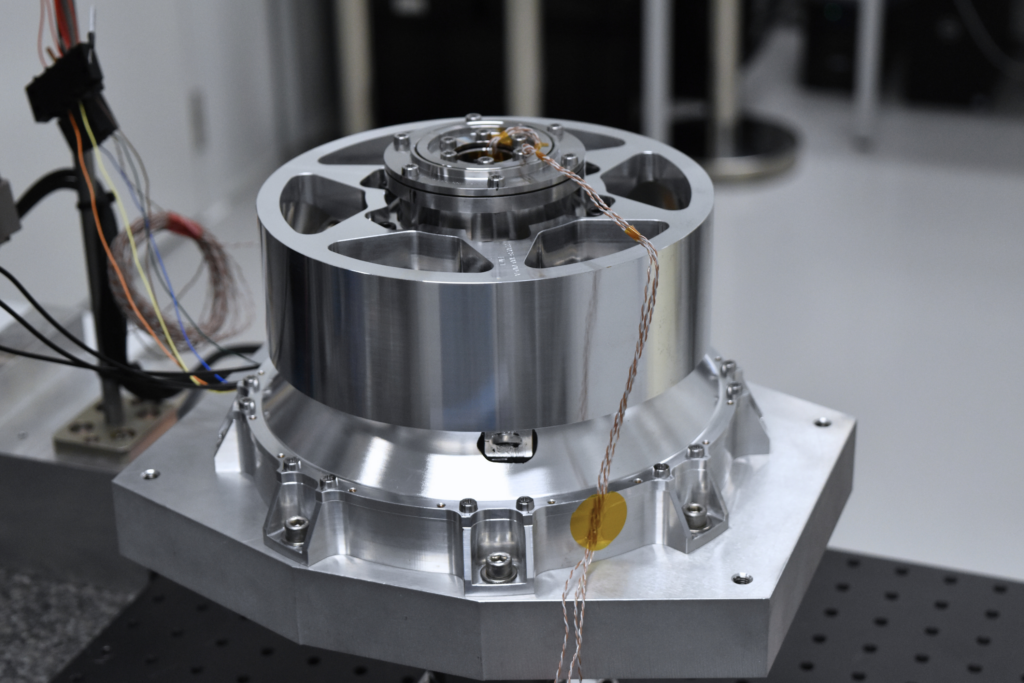
Torque defines how fast the wheel can rotate the satellite. An Earth observation mission imaging many targets per orbit needs more torque than a telecom platform holding a steady attitude.
Momentum and torque are separate requirements: a wheel can store a lot of momentum yet deliver modest torque, and the other way round.
3. Fit within the mass, volume and power budget
On a small satellite, every kilogram and every watt counts. Compare the mass and envelope of each candidate, its steady-state power at nominal speed and its peak power during acceleration. Don’t forget the electronics: depending on the design, drive electronics are integrated into the wheel or supplied as a separate unit.

4. Assess microvibrations
A spinning flywheel generates small vibrations caused by residual imbalance and bearing behaviour. For high-resolution imaging, laser communications or science instruments, this jitter can degrade performance. Ask for measured microvibration data across the full speed range, not just nominal values.
5. Treat lifetime as a selection criterion
A reaction wheel runs continuously for the whole mission. Its lifetime depends mainly on bearings and lubrication, on the speed profile and on how often it crosses zero speed. Favour suppliers who can show qualification and life test results, as well as flight heritage on comparable missions.
At Comat, testing is at the heart of design: every wheel is built to outlast the mission it serves.
6. Plan the configuration and redundancy
Three wheels are enough to control three axes, but most missions fly four wheels in a pyramid configuration. If one wheel fails, the remaining three still provide full three-axis control. This choice affects how many units you buy, and therefore how much the supplier’s production capacity matters.
Frequently asked questions
Three wheels are enough for three-axis control. Most missions carry four in a pyramid configuration so they keep full control if one wheel fails.
Momentum (in Nms) is how much angular momentum the wheel can store before it saturates. Torque (in mNm) is how quickly it can change the satellite’s attitude.
It reaches its maximum speed and can no longer absorb disturbances. The satellite then dumps the stored momentum using magnetorquers or thrusters, a process called desaturation.