




A reaction wheel is a flywheel driven by an electric motor that lets a satellite rotate and hold its orientation without using propellant. When the wheel speeds up or slows down, the satellite turns the opposite way, following the conservation of angular momentum.
The principle: conservation of angular momentum
In space, there is nothing to push against. Without external torque, the total angular momentum of the satellite and its wheel stays constant. When the motor applies a torque to the wheel, an equal and opposite torque acts on the satellite body. Spin the wheel one way and the satellite turns the other. It is the same effect as sitting on a swivel stool and spinning a bicycle wheel in your hands.
What is inside a reaction wheel
- The flywheel, with its mass concentrated at the rim to maximise inertia for a given mass.
- The brushless motor, which accelerates or brakes the flywheel precisely.
- Bearings and lubrication, the key drivers of lifetime.
- Drive electronics, which control speed or torque and return telemetry.
- The housing, which protects the assembly and keeps a controlled environment around the bearings.
Its role in the attitude and orbit control system (AOCS)
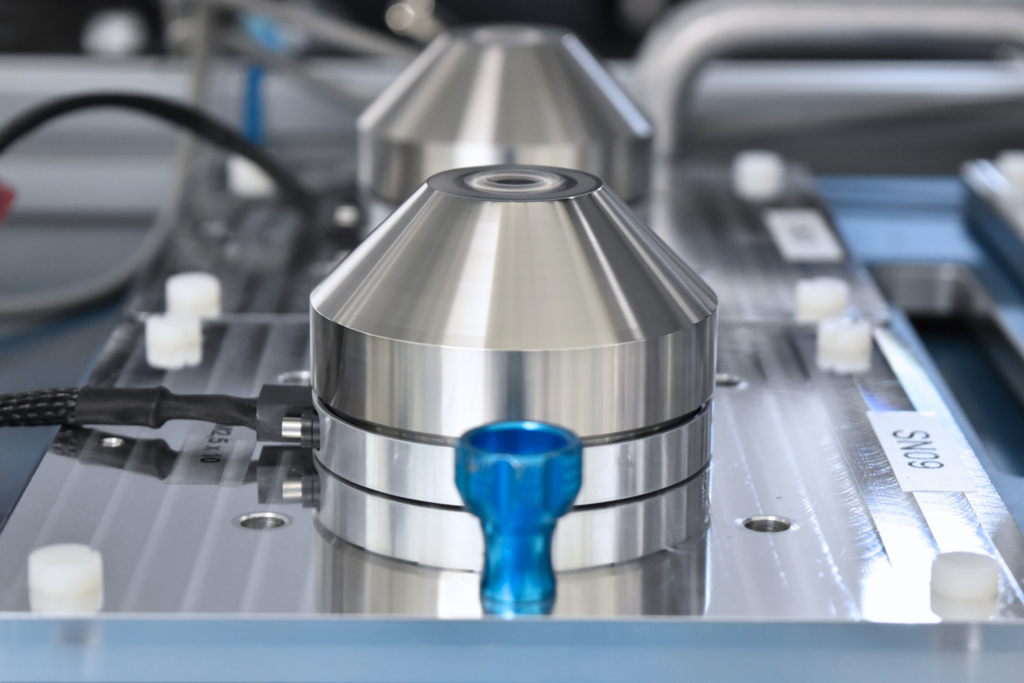
Reaction wheels are the actuators of the AOCS. Sensors such as star trackers, sun sensors, gyroscopes and magnetometers measure the satellite’s orientation.
The onboard computer calculates the correction and commands the wheels, which carry it out.
This is what allows a camera, an antenna or a science instrument to point precisely.
Saturation and desaturation
Orbit after orbit, external disturbances gradually push wheel speeds up. Once a wheel reaches its maximum speed, it is saturated and can no longer correct the attitude. The satellite then dumps the excess momentum using magnetorquers in low Earth orbit, or thrusters.

Which missions use reaction wheels?
Virtually every three-axis stabilised satellite above a few kilograms: Earth observation, telecommunications, science and exploration, and now large constellations, which need hundreds of units.
Limits to keep in mind
A reaction wheel is a mechanical device that never stops spinning. Its main limits are bearing lifetime, microvibrations transmitted to the platform, behaviour around zero speed where friction becomes non-linear, and power consumption at high speed. These are exactly the points that set one supplier apart from another.
Comat’s expertise
Comat has been designing and manufacturing space mechanisms near Toulouse, France, since 1977, with more than 200 units in orbit. Its Momentum reaction wheel range covers 1 to 50 Nms, and every model is designed and tested to outlast the mission.
Explore the Momentum range :
Frequently asked questions
A momentum wheel spins continuously around a high nominal speed to give the satellite gyroscopic stiffness. A reaction wheel operates over a variable speed range, around zero, for fine attitude control. The hardware is often very similar; the way it is used differs.
No. It runs on electricity supplied by the satellite’s solar arrays, which makes it a sustainable pointing solution for the whole mission.
Typically up to several thousand revolutions per minute, depending on the design and the target momentum capacity.